skip to main |
skip to sidebar


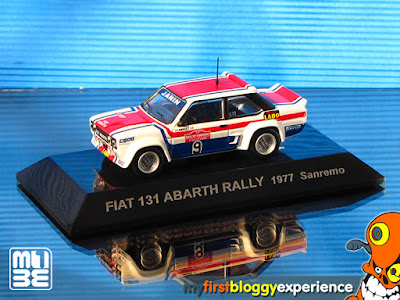






De antemano, sé que el nombre Fiat no dirá demasiado a muchas personas en algunas regiones alrededor del mundo, luego pienso que es oportuno explicar a algunos de mis visitantes que estoy hablando sobre un fabricante de autos, conocido más precisamente como Fiat Automobiles S.p.A...
Vale la pena mencionar que está marca tiene su casa matriz en Lingotto, Turín, Piedemonte, que su fundador fue Giovanni Agnelli y que en realidad es la compañía más grande de este segmento en Italia, pero sé que quizás esta no es suficiente información para algunas personas, con el fin de reconocer a Fiat entre la multitud...
Entonces, añadiré que Fiat Automobiles S.p.A., actualmente propiedad de Fiat Chrysler Automobiles, fue la dueña y/o accionista mayoritaria de Ferrari, desde 1969 hasta 2016 y tal vez esto representará un trasfondo más significativo para una marca muy importante en el mundo automotriz.
Ahora, si bien esta compañía tiene presencia global, cuando mencioné ‘algunas regiones alrededor del mundo’, quise decir particularmente países de Asia, Oceanía, Africa y Norteamérica, donde esta marca de coches es más bien poco conocida, porque, bueno, por obvias razones, en Europa es renombrada, también en Centro y Suramérica.
Es lo menos que esperas de una compañía que ya cumplió 110 años en este mercado y la cual ha recibido muchos premios internacionales por sus vehículo, así que, NO, no es una recién llegada.
Esa es, supongo, una introducción apropiada para mi invitado para esta publicación: el Auto de Carreras Rally Fiat 131 (Mirafiori) Abarth de 1976, un Super Sedán / Saloon 2 Puertas Subcompacto, derivado del Fiat 131, un sedán familiar subcompacto comercializado de 1974 a 1984, en una sola generación.
En mi patria, Colombia (Suramérica), el Fiat 131, también conocido como Mirafiori era una vista común en los 80s, cuando fue una escogencia popular para el comprador promedio (aunque, aparentemente, no tan confiable), entonces digamos que el modelo es familiar para mí y sé que fue ofrecido localmente como sedán 4 puertas y vagoneta familiar 5 puertas, con unas pocas unidades vendidas como sedanes 2 puertas.
Sin embargo, el modelo que estoy presentando hoy no es la versión de calle del 131, sino un carro de rally perteneciente al Grupo 4, un conjunto de regulaciones para rally que incluía modelos como el Ford Escort RS1800, Lancia Stratos HF o el Audi Quattro y este vehículo fue altamente modificado por Fiat, Bertone y Abarth, tres nombres que unidos deberían infundir respeto.
Mi invitado fue el ganador del (15º) Rally Sanremo de 1977, para el Equipo Fiat Francia, el # 9 fue conducido a la victoria por Jean-Claude Andruet y Christian Delferrier; mientras que el 131 regular era un carro soso en la opinión de varios periodistas automovilísticos, el coche de rally fue un contraste completo y el aspecto así como el rendimiento contribuyeron a su gran reputación, después de todo, ¡fue el carro que llevó al Lancia Stratos HF a la jubilación!...
Cuando empecé a coleccionar en serio modelos en diecast, en algún punto entre 2011 y 2012, no estaba muy familiarizado con los modelos basados en autos rally o con la disciplina de los deportes a motor en sí; aunque, por esa época, había varias opciones grandiosas a considerar, todas ellas por fuera de mi radar...
Recuerdo que durante mi infancia, solía tener un modelo Audi Quattro por Majorette (hecho en Francia), pero por alguna razón, no era particularmente atrayente para mí, prefería los Muscle Cars, vehículos utilitarios, camiones y automóviles clásicos norteamericanos en su lugar...
No obstante, todo eso cambió cuando fui introducido a los modelos creados por CM’s Corporation, una compañía japonesa muy prolífica en el segmento de los coleccionables adultos, con un amplio rango de productos en varias líneas, incluyendo figuras de acción en PVC, chogokins (figuras de acción con partes en diecast) y, desde luego, modelos en diecast.
Poco a poco estoy compartiendo algo de información que he estado reuniendo sobre CM’s y una de las malas noticias es que desafortunadamente hoy en día está fuera del negocio.
Si bien esta compañía fue objeto de muchas críticas, algunas veces con justificación, fue pionera en muchos aspectos, de hecho fue una de las marcas que ayudó a consolidar el mercado de los coleccionables Premium y cuando se trata de modelos en diecast, estableció un estándar muy alto, en muchos casos incluso más alto que lo que ha sido ofrecido por marcas como Kyosho, Tomica Limited Vintage o Minichamps...
Conseguí esta maravillosa réplica a escala en el mercado secundario, con la ayuda de un amigo mío, colega coleccionista e importador, hace más o menos 3 años; pertenece a la Serie 1:64 Rally Car Collection de 2008 y fue una de las últimas líneas ofrecida antes de la extinción de CM’s.
A diferencia de las series anteriores que venían dentro de cajas selladas, una presentación usual para esta clase de artículos en el mercado japonés, este venía en una presentación más internacional: caja con ventana, que te permite ver claramente este producto Premium y estar complacido.
Qué enorme diferencia con lo que algunas compañías de diecast se atreven a llamar "premium" actualmente; cuando se trata de distorsionar el concepto de Premium, algunos fabricantes de diecast no tienen muchos reparos, ¿EH?...
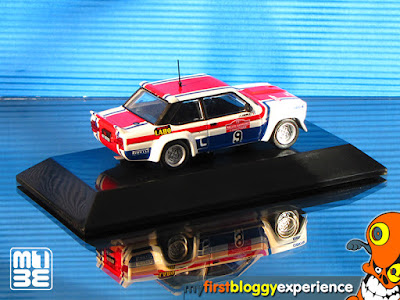
Tiene carrocería en diecast y chasis en plástico negro, que recibió tampos plateados; el trabajo de pintura y decoración de carreras son pasmosos, reproduciendo bastante fielmente lo que ves en el coche real, la decoración fue hecha con tampos y/o calcomanías, una obligación en la categoría Premium y nada menos que eso, realismo y precisión en su máxima expresión.
Hay insertos plásticos para las luces frontales, de niebla y de cola, curiosamente no incluye la jaula de seguridad dentro de la cabina, pero hay una antena moldeada y removible, los espejos retrovisores laterales fueron moldeados con la carrocería, incluye tampos y/o calcomanías adicionales para los limpiabrisas frontales y algunos logos en el parabrisas y las ventanas laterales.
Los interiores fueron finamente moldeados, como siempre, las ruedas son multiparte, reproduciendo el diseño de rimes Abarth Cromodora 4 Spoke Tarmac specs Grupo 4 en plateado y tiene llantas en caucho labradas, incluye una linda base de exhibición negra con el nombre del modelo impreso en plateado, acabado brilloso, cubierta acrílica transparente y fue hecho en China...
Ecl 3:9-14 "¿Qué provecho tiene el que trabaja, de aquello en que se afana? Yo he visto el trabajo que DIOS ha dado a los hijos de los hombres para que se ocupen en él. Todo lo hizo hermoso en su tiempo; y ha puesto eternidad en el corazón de ellos, sin que alcance el hombre a entender la obra que ha hecho DIOS desde el principio hasta el fin. Yo he conocido que no hay para ellos cosa mejor que alegrarse, y hacer bien en su vida; y también que es don de DIOS que todo hombre coma y beba, y goce el bien de toda su labor. He entendido que todo lo que DIOS hace será perpetuo; sobre aquello no se añadirá, ni de ello se disminuirá; y lo hace DIOS, para que delante de él teman los hombres."
ENGLISH
Beforehand, I know that the name Fiat will not say too much to many people in some regions around the world, so I think it’s timely to explain to some of my visitors that I’m talking about a carmaker, known more precisely as Fiat Automobiles S.p.A...
It’s worth mentioning also that this brand is headquartered in Lingotto, Turin, Piedmont, that its founder was Giovanni Agnelli and that actually it’s the largest company of this segment in Italy, but I know that perhaps this is not enough information for some people, to recognize Fiat among the crowd...
Then, I will add that Fiat Automobiles S.p.A., currently property of Fiat Chrysler Automobiles, was the owner and/or controlling shareholder of Ferrari, from 1969 to 2016 and maybe this will represent a more significant background for a very important brand in the automotive world.
Now, while this company has global presence, when I mentioned ‘some regions around the world’, I meant particularly countries of Asia, Oceania, Africa and North America, where this car brand is rather little known, because, well, for obvious reasons, in Europe is renowned, also in Central and South America.
It’s the least you expect from a company that already turned 110 years in this market and which has received many international awards for its vehicles so, NO, it’s not a newcomer.
That’s, I guess, a proper introduction for my guest in this publication: the 1976 Fiat 131 (Mirafiori) Abarth Rally Racing Car, a Subcompact 2-Door Super Sedan / Saloon, derived from the Fiat 131, a subcompact family sedan marketed from 1974 to 1984, in a single generation.
In my homeland, Colombia (South America), the Fiat 131, also known as Mirafiori was a common sight in the 80s, when it was a popular choice for the average buyer (albeit, apparently, not so reliable), then let’s say that the model is familiar for me and I know that it was offered locally as 4-door sedan and 5-door state / station wagon, with few units sold as 2-door sedans.
However, the model I’m featuring today is not the street version of the 131, but a rally car belonging to the Group 4, a set of regulations for rallying that included models like the Ford Escort RS1800, Lancia Stratos HF or the Audi Quattro and this vehicle was heavily modified by Fiat, Bertone and Abarth, three names that united should instill respect.
My guest was the winner of the (15th / 15e) 1977 Rallye Sanremo, for the Fiat France Team, the # 9 was driven to victory by Jean-Claude Andruet and Christian Delferrier; while the regular 131 was a dull car in the opinion of several automotive journalists, the rally car was a complete contrast and the look as well as the performance contributed to its great reputation, after all, it was the car that led the Lancia Stratos HF to retirement!...
When I started to collect seriously diecast models, at some point between 2011 and 2012, I was not very familiar with models based on rally cars or with the motorsports discipline itself; although, by that time, there were several great options to consider, all of them out of my radar...
I remember that during my infancy, I used to have an Audi Quattro model by Majorette (made in France), but for some reason, it was not particularly alluring for me, I preferred Muscle Cars, utilitarian vehicles, trucks and classic American automobiles instead...
Nonetheless, all that changed when I was introduced to the models created by CM’s Corporation, a very prolific Japanese company in the segment of adult collectibles, with a wide range of products in several lines, including action figures in PVC, chogokins (action figures with diecast parts) and of course, diecast models.
Little by little I’m sharing some information I have been gathering about CM’s and one of the bad news is that unfortunately nowadays it’s out of business.
While this company was the subject of much criticism, sometimes with justification, it was pioneer in many aspects, in fact it was one of the brands that helped to consolidate the market of Premium collectibles and when it comes to diecast models, it established a very high standard, in many cases even higher than what has been offered by brands like Kyosho, Tomica Limited Vintage or Minichamps...
I got this wonderful scale replica in the secondary market, with the help of a friend of mine, fellow collector and importer, pretty much 3 years ago; it belongs to the 2008 1:64 Rally Car Collection Series and it was one of the latest lines offered before the extinction of CM’s.
Unlike the previous series that came inside blind boxes, an usual presentation for this kind of items in the Japanese market, this one came in a more international presentation: window box, that let’s you see clearly this Premium product and being pleased.
What a huge difference with what some diecast companies dare to call "premium" currently; when it comes to distort the concept of Premium, some diecast manufacturers don’t have much qualms, HUH!...
It has diecast body and black plastic chassis, that received silver tampos; the paint job and racing decoration are astonishing, reproducing quite faithfully what you see in the actual car, the decoration was made with tampos and/or decals, a must in the Premium category and nothing less than that, realism and accuracy at their best.
There are plastic inserts for the front, fog and tail lights, curiously it doesn’t include the safety cage inside the cabin, but there is a molded and detachable antenna, the side rearview mirrors were molded with the body, it includes additional tampos and/or decals for the front wipers and some logos on the windshield and side windows.
The interiors were finely molded, as always, the wheels are multipart, reproducing the Abarth Cromodora 4 Spoke Tarmac specs Group 4 rims design in silver and styled rubber tires, it includes a nice black display base with the name of the model printed in silver, glossy finishing, acrylic clear cover and it was made in China...
Ecc 3:9-14 "What profit hath he that worketh in that wherein he laboreth? I have seen the travail, which GOD hath given to the sons of men to be exercised in it. He hath made every thing beautiful in his time: also he hath set the world in their heart, so that no man can find out the work that GOD maketh from the beginning to the end. I know that there is no good in them, but for a man to rejoice, and to do good in his life. And also that every man should eat and drink, and enjoy the good of all his labor, it is the gift of GOD. I know that, whatsoever GOD doeth, it shall be forever: nothing can be put to it, nor any thing taken from it: and GOD doeth it, that men should fear before him."


La historia de Chrysler, justo como ocurrió con otras compañías en el segmento de la fabricación de autos ha visto muchos cambios, altibajos, pero sobrevive a la fecha, lo cual no es poco decir en un mercado tan fuertemente competitivo y azaroso...
Es interesante mencionar que Chrysler Corporation no comenzó como una marca propia: se levantó de las cenizas de Maxwell Motor Company (MMC), fundada en 1904 por Johnathan Maxwell y Benjamin Briscoe...
Debido a una expansión más bien incontrolada, con el fin de producir muchas clases de vehículos para diferentes presupuestos, Maxwell Motor enfrentó las consecuencias de adquirir una deuda enorme y encima de eso, en tiempos de recesión...
En ese momento, Walter Chrysler entró en escena y tomó las riendas de MMC, para 1925 la marca estaba oficialmente extinta, cuando fue absorbida por Chrysler Corporation, aunque uno de sus productos fue la base para el primer Plymouth y su filosofía de innovación continuó.
La misma Chrysler Corporation, luego de un periodo de expansión adquiriendo marcas como Fargo Trucks, Dodge Brothers y desarrollando sus propias marcas: Plymouth y Desoto, tuvo que padecer varios momentos críticos.
En los 50s, durante el periodo posterior a la II Guerra Mundial, en los 60s cuando trató de expandir su negocio a Europa, en los 70s con la "crisis petrolera" y el endurecimiento de las regulaciones ambientales en los EE.UU.; experimentó una especie de estabilidad financiera durante los 80s y 90s, pero en los 2000s, estuvo involucrada en una crisis generalizada de la industria automotriz y desde 2014, fue fusionada a Fiat y renombrada como Fiat Chrysler Automobiles.
Esos son un montón de cambios si me lo preguntas; no obstante, hay algo que permanece inalterable en esta compañía y es su inclinación consistente hacia el segmento de lujo como sello distintivo de Chrysler.
Mi invitado para esta publicación es, al menos hasta que el Chrysler Imperial Concept se convierta en realidad, el buque insignia de esta marca: el Chrysler 300S de 2015, donde la "S" significa Sport, un Sedán de Lujo de Tamaño Completo 4 Puertas Notchback que pertenece a la segunda generación del modelo.
El diseño original para el 300, lanzado en 2005, estuvo en las manos de Ralph Gilles y Freeman Thomas; este diseño fue el objeto de duras críticas y en ciertos círculos fue despectivamente comparado los sedanes de lujo superior hechos por Bentley (supongo que el Arnage y/o el Flying Spur fueron los referentes).
Bueno, pienso que esta comparación está "un poquitín" fuera de lugar, especialmente viniendo de "expertos" en temas automovilísticos que ni siquiera son diseñadores para empezar; si bien no es un diseño absolutamente único, porque es inevitable encontrar reminiscencias de modelos de otras marcas (los modelos Bentley no son únicos en ese sentido tampoco), el Chrysler 300 tiene su propio carácter.
A diferencia de otras ofertas en el mismo segmento y nivel de precio, el reciente Chrysler 300 es un sedán de lujo con actitud y estilo muy atrayente, uno que luce vigoroso, atrevido, con la dosis correcta de clase pero también con temperamento.
Esto es logrado a través de un tren de potencia más que capaz: un motor de 220 pulgadas cúbicas, 3.6 L, DOHC VVT Pentastar V6, clasificado en 300 hp (Tracción Trasera o Tracción en las 4 Ruedas), la opción de un motor de 346 pulgadas cúbicas, 5.7 L, HEMI V8, clasificado en 363 hp (solo Tracción Trasera), ambos acoplados a una transmisión automática TorqueFlite de 8 velocidades e incluso hay la opción de un motor diesel para ciertos mercados; ¡indudablemente, una oferta singular para un segmento más bien aburrido!...
No me culpes si aún estoy preguntándome cuál es la política actual de distribución que Mattel pretendidamente ha desarrollado para Matchbox: simplemente no puedo encontrar nada claro o conveniente para nosotros en esta materia y estoy completamente seguro que otros coleccionistas serios se están preguntando exactamente lo mismo...
El hecho que el gigante rojo de los juguetes no ha tenido un pronunciamiento oficial al respecto por tanto tiempo (5 u 8 años desde que la distribución empezó a empeorar radicalmente), no ayuda mucho a la ya golpeada imagen de una marca que tiene una historia y reputación mayor que la de la marca azul de Mattel, ¿no es así?...
Uno diría que no hay política en absoluto, porque hoy en día es realmente difícil conseguir los lanzamientos más recientes (o cualquier otro lanzamiento reciente para el caso), cuando se trata de modelos basados en vehículos reales, a través de los canales regulares de distribución, pero el hecho que Mattel sigue bombeando nuevos modelos para su marca naranja simplemente no encaja con esta suposición...
Ahora, en mi patria, Colombia, todavía tienes el chance de conseguir algunos modelos en tiendas minoristas, lo cual es algo que coleccionistas de otros países no se pueden dar el lujo de decir; sin embargo, la única tendencia consistente que he visto hasta aquí en este asunto es que todo va de mal en peor.
"Curiosamente", la situación parece ser diferente en el mercado secundario y particularmente en el detestable mercado paralelo (o simplemente mercado falso) de acaparadores y especuladores, donde no hay escasez de modelos, lo que me hace preguntarme: ¿está Mattel inclinándose hacia el mercado secundario cuando se trata de distribución para Matchbox (y últimamente también para Hot Wheels)?...
Con toda honestidad, no creo que Mattel haría una declaración oficial en ese sentido: el impacto en coleccionistas promedio sería muy negativo, sin hablar de los coleccionistas leales de Matchbox y ya estamos viendo este impacto negativo; simplemente porque esta marca nunca estuvo destinada a ser una especie "exclusividad por correo" o "edición limitada", solo disponible para una especie de "élite" de "coleccionistas" que pueden costear semejantes "excentricidades" (en realidad, un grupo de idiotas que quiere alardear de su ignorancia, derochando dinero), sino una marca para estar disponible ampliamente por un precio razonable.
Quizás no es una posición oficial de Mattel, pero en la práctica eso es exactamente lo que percibes y recuerdo que en el pasado (cuando ya Mattel había tomado el control de la marca británica) hubo intentos de cambiar el perfil de Matchbox entre los coleccionistas hacia algo más "premium-esco".
Los resultados de esta estrategia no fueron los esperados y en realidad no ayudaron a impulsar la popularidad de esta marca en un mercado competitivo; no creo que la historia sea diferente hoy en día, ya que los coleccionistas serios son mucho más exigentes que antes y si comparas lo mejor hecho por Matchbox no puede tener oportunidad contra lo que ofrecen las marcas verdaderamente Premium actuales, la diferencia es bastante notoria en muchos casos.
No estoy diciendo que la calidad de los productos de Matchbox no es buena en términos generales: lo es, pero todavía no lo suficientemente buena para algo Premium y eso está bien, ya sabemos que esperar y que no esperar de esta marca; al final, estamos hablando de una caja de fósforos, no de un encendedor muy fino, si sabes a lo que me refiero...
Mattel no tiene que reinventar lo que ya está inventado, lo que esta compañía realmente necesita hacer es implementar un manejo "premium" del proceso de distribución, trabajando en estrecha colaboración con sus clientes grandes y dando prioridad al mercado primario: esto tendrá un impacto positivo mucho mayor a corto, mediano y largo plazo que cualquier estrategia de venta directa al mercado secundario...
Conseguí el modelo presentado en esta reseña a través de los canales regulares de distribución, hace más de 1 año, fue uno de esos hallazgos que ocasionalmente consigues en ciertas tiendas minoristas, que están llegando a ser más escasas con el tiempo; pertenece a la Serie MBX Adventure City - Regular 1-125 de 2016 y hasta ahora solo 3 iteraciones han sido hechas.
Tiene carrocería en diecast y chasis en plástico negro, como es usual el nivel de detalle y acabados son muy buenos para su categoría, pero un modelo como este merece una escala más grande (1:64 sería grandioso, 1:67 luce un poco enano para mi gusto); el trabajo de pintura fue hecho en magenta con acabado Metalflake (el color del coche real es más rojizo, pero el magenta funciona bastante bien en este Chrysler 300S), complementado por tampos y/o calcomanías para los faros y parrilla frontales, más las luces, moldura debajo de la tapa del baúl, emblemas Chrysler y 300S traseros, colocados con precisión: la calidad Matchbox está todavía allí, afortunadamente.
Los interiores fueron trabajado en negro mientras que las ventanas son ahumadas, esto definitivamente ayuda al realismo, otro rasgo en modelos Matchbox; las ruedas plásticas presentan diseño de rimes Split 10 Spoke en cromado que si bien es más apropiado para el Chrysler 300 o 300C Platinum, no luce mal en este 300S y fue hecho en Tailandia...
Miq 7:7-10 "Más yo a JEHOVÁ miraré, esperaré al DIOS de mi salvación; el DIOS mío me oirá. Tú, enemiga mía, no te alegres de mí, porque aunque caí, me levantaré; aunque more en tinieblas, JEHOVÁ será mi luz. La ira de JEHOVÁ soportaré, porque pequé contra él, hasta que juzgue mi causa y haga mi justicia; él me sacará a luz; veré su justicia. Y mi enemiga lo verá, y la cubrirá vergüenza; la que me decía: ¿Dónde está JEHOVÁ tu DIOS? Mis ojos la verán; ahora será hollada como lodo de las calles."
ENGLISH
The history of Chrysler, just like it has happened with other companies in the segment of car manufacturing, has seen many changes, ups and downs, but it survives to date, which is not little to say in a market so strongly competitive and venturesome...
It’s interesting mentioning that Chrysler Corporation didn’t start as a brand of its own: it arouse from the ashes of Maxwell Motor Company (MMC), founded in 1904 by Johnathan Maxwell and Benjamin Briscoe...
Due to a rather uncontrolled expansion in order to produce a bit too many kinds of vehicles for different budgets, Maxwell Motor faced the consequences of acquiring a huge debt and on top of that, in times of recession...
At that moment, Walter Chrysler entered the scene and took over the reins of MMC, by 1925 the brand was officially extinct when it was absorbed by Chrysler Corporation, albeit one of its products was the base for the first Plymouth and its philosophy of innovation continued.
Chrysler Corporation itself, after a period of expansion acquiring brands like Fargo Trucks, Dodge Brothers and developing its own brands: Plymouth and Desoto, had to undergo several critical moments.
In the 50s, during the post II World War period, in the 60s when it tried to expand its business in Europe, in the 70s with the "oil crisis" and the hardening of environmental regulations in U.S.; it experienced a sort of financial stability during the 80s and 90s, but in the 2000s, it was involved in a widespread crisis of the automotive industry and since 2014, it was merged to Fiat and renamed as Fiat Chrysler Automobiles.
Those are a lot of changes if you ask me; nonetheless, there is something that remains unalterable in this company and it’s the consistent lean towards luxury segment as Chrysler’s hallmark.
My guest for this publication is, at least until the Chrysler Imperial Concept becomes a reality, the flagship of this brand: the 2015 Chrysler 300S, where the "S" stands for Sport, a Full Size 4-Door Notchback Luxury Sedan that belongs to the second generation of the model.
The original design for the 300, released in 2005, was in the hands of Ralph Gilles and Freeman Thomas; this design was the subject of harsh criticism and in certain circles it was disparagingly compared with the top luxury sedans made by Bentley (I guess the Arnage and/or the Flying Spur were the referents).
Well, I think this comparison is "a bit" out of place, specially coming from "experts" in automotive topics who are not even designers to begin with; while it’s not an absolutely unique design, because it’s unavoidable to find reminiscences of models by other brands (the Bentley models are not unique in that sense either), the Chrysler 300 has its own character.
Unlike other offers in the same segment and level of price, the recent Chrysler 300 is a luxury sedan with attitude and a very attractive styling, one that looks vigorous, daring, with the right dose of class but also with temperament.
This is achieved through a more than capable powertrain: a 220 cu in, 3.6 L, DOHC VVT Pentastar V6 engine, rated at 300 hp (Rear Wheel Drive or 4 Wheel Drive), the option of a 346 cu in, 5.7 L, HEMI V8 engine, rated at 363 hp (only Rear Wheel Drive), both coupled to a 8-speed TorqueFlite automatic transmission and even there is the option of a diesel engine for certain markets; undoubtedly, a singular offer in a rather boring segment!...
Don’t blame me if I’m still wondering what’s the current policy of distribution that Mattel allegedly has developed for Matchbox: I just can’t find anything clear or convenient for us in this matter and I’m completely sure other serious collectors are wondering exactly the same...
The fact that the red giant of toys hasn’t had an official pronouncement about it for so long (5 or 8 years since distribution began to worsen radically), doesn’t help much in the already battered image of a brand that has a greater history and reputation than the blue brand of Mattel, ain’t it?...
One would say that there is no policy at all, because nowadays it’s really difficult to get the latest releases (or any other recent release for the case), when it comes to models based on actual vehicles, through the regular channels of distribution, but the fact that Mattel keeps pumping new models for its orange brand just doesn’t fit in this assumption...
Now, in my homeland, Colombia, you still have the chance to get some models in retail stores, which is something that collectors from other countries cannot afford to say; however, the only consistent trend I have seen so far on this subject is that everything goes from bad to worse.
"Curiously", the situation seems to be different in the secondary market and particularly in the detestable parallel market (or just fake market) of hoarders and scalpers, where there is no shortage of models, which makes me wonder: is Mattel leaning towards the secondary market when it comes to distribution for Matchbox (and lately for Hot Wheels too)?...
In all honesty, I don’t think Mattel would make an official statement in that sense: the impact on average collectors would be very negative, let alone the impact on loyal collectors of Matchbox and we are already seeing this negative impact; just because this brand was never meant to be a sort of "mail-in exclusive" or "limited edition", only available for a sort of "elite" of "collectors" who can afford such "eccentricities" (actually, a group of idiots who want to brag about their ignorance, squandering money), but a brand to be widely available for a reasonable price.
Perhaps it’s not an official position of Mattel, but in the practice that’s exactly what you perceive and I remember that in the past (when Mattel had already taken control of the British brand) there were attempts to change the profile of Matchbox among collectors towards something more "premium-esque".
The results of this strategy were not as expected and actually didn’t help to boost the popularity of this brand in a competitive market; I don’t think the history will be different nowadays, since serious collectors are much more demanding than before and if you compare the best made by Matchbox it just cannot stand a chance against what the current truly Premium brands offer, the difference is quite noticeable in many cases.
I’m not saying that the quality in Matchbox products is not good in general terms: it is, but it’s still not good enough for something Premium and that’s fine, we already know what to expect and what not to expect from this brand; in the end, we are talking about a matchbox, not about a very fine lighter, if you know what I mean...
Mattel doesn’t have to reinvent what’s already invented, what this company really needs to do is to implement a "premium" management of the distribution process, working closely with its large customers and giving priority to the primary market: it will have a much greater positive impact in the short, medium and long term than any strategy of direct sales to the secondary market...
I got the model featured in this review through the regular channels of distribution, more than 1 year ago, it was one of those findings that you occasionally get in certain retail stores, which are becoming scarcer over time; it belongs to the 2016 MBX Adventure City - Regular 1-125 Series and until now only 3 iterations have been made.
It has diecast body and black plastic chassis, as usual the level of detail and finishes are very good for its category, but a model like this deserves a larger scale (1:64 would be great, 1:67 looks a bit dwarf for my taste); the paint job was made in magenta with Metalflake finishing (the color of the actual car is more reddish, but magenta works pretty fine in this Chrysler 300S), complemented by tampos and/or decals for the front grille and headlamps, plus the rear lights, molding below the trunk lid, Chrysler and 300S emblems, accurately placed: the Matchbox quality is still there, fortunately.
The interiors were worked in black while the windows are smoked, it definitely helps to realism, another trait in Matchbox models; the plastic wheels feature Split 10 Spoke rims design in chrome that while is more appropriate for the Chrysler 300 or 300C Platinum, it doesn’t look bad in the 300S and it was made in Thailand...
Mic 7:7-10 "Therefore I will look unto the LORD; I will wait for the GOD of my salvation: my GOD will hear me. Rejoice not against me, O mine enemy: when I fall, I shall arise; when I sit in darkness, the LORD shall be a light unto me. I will bear the indignation of the LORD, because I have sinned against him, until he plead my cause, and execute judgment for me: he will bring me forth to the light, and I shall behold his righteousness. Then she that is mine enemy shall see it, and shame shall cover her which said unto me: where is the LORD thy GOD? Mine eyes shall behold her: now shall she be trodden down as the mire of the streets."


La vida suele ser bastante "irónica", especialmente para aquellos que creen en la suerte, la casualidad o la aleatoriedad...
De acuerdo con la lógica humana, si actuamos de cierta manera, esperando conseguir un resultado específico y nos esforzamos en ello, pero logramos en vez de eso algo diferente, es porque la vida debe ser azarosa y eso es una completa ironía...
Suena razonable pero, ¿qué tiene que ver la vida con la aleatoriedad y la ironía, o incluso, qué tiene la aleatoriedad que ver con la ironía?...
Si me lo preguntas, no creo en los hechos fortuítos, sino en un propósito detrás de todo; para mí, si algo está destinado a suceder, sucederá, sin importar las circunstancias particulares, intenciones o expectativas de nosotros, los seres humanos.
La "ironía" de la vida está solo en nuestros ojos, es solo nuestra interpretación de lo que sucede a nuestro alrededor; en otras palabras, la ironía está en nuestra mente, la vida es lo que es, podría ser sin sentido o significativa para nosotros, pero esa es solo nuestra percepción.
En realidad, si piensas detenidamente en esto, la ironía tiene muy poco que ver con la aleatoriedad...
Por ejemplo, podrías decir que esta publicación, donde un Ferrari es presentado por primera vez en este blog, como el tema principal, fue absolutamente aleatoria y ¿cómo podrías saberlo con certeza, en todo caso?...
Bueno, si eres un visitante regular de este sitio, concebiblemente no lo esperarías, pues ya afirmé que Ferrari no es mi obsesión y he vociferado sobre esta marca de autos antes, más de una vez...
Pero, ¿cómo tal percepción tuya hace esta publicación una cuestión del azar?...
El hecho que no podrías predecirla, no la hace aleatoria, ¿correcto? =PPPPP...
Preparé esta publicación a propósito, fue mi plan para mostrar con hechos, que admiro algunos vehículos de Ferrari, pero no necesariamente al creador de esta marca o a la gente que posee un coche como este así que, no hay nada accidental sobre esto...
No obstante, esta publicación no está desprovista de ironía, ya que seleccioné un modelo que fue considerado un "mestizo" o incluso un "hijo bastardo" por Enzo y los rabiosos puristas de esta marca...
En caso que no lo supieras, Enzo Ferrari estaba tan obsesionado con sus carros de carreras V12, que cualquier otra cosa, incluyendo sus propios autos de calle y otros con menos cilindros (V6 o V8), fueron considerados simplemente "males necesarios" (!?)...
A pesar de la aplastante evidencia del mercado automotriz alrededor suyo, Enzo era reacio a aceptar la importancia cardinal de los modelos de calle y menos poderosos en su portafolio, para la supervivencia de su negocio.
Dino fue básicamente una división de Ferrari, responsable por la creación de coches deportivos de motor central con tracción trasera, dirigidos a un mercado con menor poder adquisitivo y en el mismo segmento que el Porsche 911.
El Ferrari Dino 246 fue el primer modelo producido en masa por Ferrari; sin embargo, Enzo no quería "manchar" el prestigio de su exclusiva marca, con un carro más barato que sus modelos V12 así que, este modelo fue designado solo Dino hasta 1976, cuando recibió la insignia Ferrari.
El "hijo bastardo" fue reconocido finalmente y no hizo ninguna diferencia, el hecho que fue una "aventura conjunta" entre Ferrari y Fiat.
El -Gran Turismo Spyder- Ferrari Dino 246 GTS Serie E de 1972, fue el sucesor del Dino 206 GT, diseñado originalmente por Leonardo Fioravanti en Pininfarina y construido por Carrozzeria Scaglietti.
Hace gala de un diseño de carrocería estupendo, donde curvas voluptuosas le dan un encanto irresistible, combinadas con algo de la extravagancia de los 70s, en una silueta limpia y compacta que te seduce.
En verdad, tiene el ADN de Ferrari, a pesar del escepticismo del propio Enzo; el tiempo y la historia probaron cuán equivocado estaba él, por despreciar las invenciones creadas al amparo de su propia marca.
La carrocería y la mayor parte del motor tuvieron originalmente una construcción en aluminio, pero con el fin de ahorrar costos, este material fue reemplazado por acero o hierro; con todo, el diseño de carrocería permaneció prácticamente intacto y el motor recibió más poder.
Hablando del tren de potencia, era un motor de 147.6 pulgadas cúbicas, 2.4 L, Dino V6, clasificado entre 175 y 195 hp (versiones norteamericana y europea, respectivamente), con sistema de encendido Magneti Marelli AEC103A, 3 carburadores Weber 40 DCNF/6 ó 40 DCNF/7 y acoplado a una transmisión manual sincronizada de 5 velocidades, ¡para un excelente desempeño con un montón de estilo!...
Ahora, ¿no es irónico que decidiera publicar un Ferrari hecho por Hot Wheels, precisamente cuando esta marca de diecast tuvo que aceptar el hecho que May Cheong Group, el conglomerado dueño de Maisto, ha comprado y recuperado las licencias para fabricar diecast de Ferrari, bajo su marca Bburago?...
Quizás (risa secreta), pero noten que no soy un oportunista, porque adquirí este modelo mucho antes que las noticias ya mencionadas fueran reveledas, incluso antes que fueran rumores; simplemente tengo un buen ojo, eso es todo, no me culpes por tener buen gusto =PPPPP...
Creo que Hot Wheels hizo un hermoso trabajo en este molde, probablemente, esto es porque éste ha sido siempre parte de líneas adultas; increíblemente, no hay mención del diseñador involucrado en su creación; ¡alguien debe ser acreditado por un modelo sobresaliente!...
Su debút fue en el set que estoy publicando hoy: la Serie Bruce Wayne Collection en 2004 y después de 5 años, fue revisitado en otra línea Adulta: la Serie Ferrari Racer de 2009 con dos variaciones así que, es un molde reciente.
Incluyendo el reseñado aquí, ha sido usado solo en cuatro series, la última vez, como parte de la línea Retro Entertainment.
Tiene carrocería y chasis en diecast, ambos recibieron un rico trabajo de pintura en negro, con acabado Metalflake y el modelo luce realmente bien así; además, tiene tampos para los bómperes parciales frontales y traseros, las luces delanteras, el emblema de Dino al frente de la tapa del maletero, las luces de cola y el parabrisas; los interiores son negros y agradablemente detallados, las ruedas son multiparte, con diseño de rimes Preferred Series en cromado, llantas labradas en caucho Real Riders y fue hecho en China.
El plus aquí es una base de exhibición, donde los modelos pueden ser fijados usando tornillos e incluye una mini-figura de Jaime (el mayordomo de Bruno Díaz), que encaja muy bien, probablemente pintada a mano, aunque no hay cubierta acrílica transparente...
Luc 14:25-30 "Grandes multitudes iban con JESÚS; y volviéndose, les dijo: Si alguno viene a MÍ, y no aborrece a su padre, y madre, y mujer, e hijos, y hermanos, y hermanas, y aún también su propia vida, no puede ser mi discípulo. Y el que no lleva su cruz y viene en pos de MÍ, no puede ser mi discípulo. Porque ¿quién de vosotros, queriendo edificar una torre, no se sienta primero y calcula los gastos, a ver si tiene lo que necesita para acabarla? No sea que después que haya puesto el cimiento, y no pueda acabarla, todos los que lo vean comiencen a hacer burla de él, diciendo: este hombre comenzó a edificar, y no pudo acabar."
ENGLISH
Life use to be quite "ironic", specially for those who believe in luck, happenstance or randomness...
According to human logic, if we act in certain way, hoping to get a specific result and we strive to do so, but we get instead something different, it’s because life must be haphazard and that’s a whole irony...
Sounds reasonable but, what has life to do with randomness and irony, or even, what has randomness to do with irony?...
If you ask me, I don’t believe in fortuitous events, but in a purpose behind everything; for me, what is meant to happen, will happen, regardless the particular circumstances, intentions or expectations of us, the human beings.
The "irony" of life is only in our eyes, is only our interpretation of what happens around us; in other words, the irony is in our mind, the life is what it is, it could be meaningless or meaningful for us, but that’s only our perception.
Actually, if you think carefully about it, irony has very little to do with randomness...
For instance, you could say that this publication, where a Ferrari is featured for the first time in this blog, as the main topic, was absolutely random and how you could know it for sure, anyway?...
Well, if you’re a regular visitor of this site, conceivably you would not expect it, since I already stated that Ferrari is not my obsession and I have ranted about this car brand before, more than once...
But, how such a perception of yours makes this publication a matter of chance?...
The fact that you could not predict it, doesn’t make it random, right? =PPPPP...
I prepared this publication on purpose, it was my plan to show with facts, that I admire some Ferrari vehicles, but not necessarily to the creator of this brand or to the people who own a car like this so, there was nothing accidental about it...
Nonetheless, this publication is not devoid of irony, since I selected a model that was considered a "half-breed" or even a "bastard child" for Enzo and the rabid purists of this brand...
In case you didn’t know, Enzo Ferrari was so obsessed with his V12 racing cars, than anything else, including his own street cars and others with fewer cylinders (V6 or V8), were simply considered a "necessary evil" (!?)...
Despite the crushing evidence of the automotive market around him, Enzo was reluctant to accept the cardinal importance of the street and less powered models in his portfolio, for the survival of his business.
Dino was basically a division of Ferrari, responsible for producing mid-engine sports cars with rear wheel drive, aimed to a market with lower purchasing power and in the same segment of the Porsche 911.
The Ferrari Dino 246 was the first mass produced model made by Ferrari; however, Enzo didn’t want to "stain" the prestige of his exclusive brand, with a car cheaper than his V12 models so, this model was designated only Dino until 1976, when it received the Ferrari badge.
The "bastard son" was finally recognized and it made no difference, the fact that it was a "joint-venture" between Ferrari and Fiat.
The 1972 Ferrari Dino 246 GTS Series E -Grand Tourer Spyder-, was the successor of the Dino 206 GT, designed originally by Leonardo Fioravanti at Pininfarina and built by Carrozzeria Scaglietti.
It displays a terrific body design, where voluptuous curves give it an irresistible charm, combined with some of the extravagance of the 70s, in a clean and compact shape that seduces you.
Indeed, it has the Ferrari DNA, despite the skepticism of Enzo himself; time and history proved how wrong he was, for despising the inventions created under his own brand.
The body and most of the engine had originally an aluminum construction, but in order to save costs, this material was replaced by steel or iron; yet, the body design remained virtually intact and the engine received more power.
Talking about the powertrain, it was a 147.6 cu in, 2.4 L, V6 Dino engine, rated at between 175 and 195 hp (american and european versions, respectively), with Magneti Marelli AEC103A ignition system, 3 Weber 40 DCNF/6 or 40 DCNF/7 carburetors and coupled to a 5-speed manual all-synchromesh transmission, for an excellent performance with a lot of style!...
Now, isn’t it ironic that I decided to publish a Ferrari made by Hot Wheels, precisely when this diecast brand had to accept the fact that May Cheong Group, the conglomerate owner of Maisto, has purchased and regained the licenses to manufacture Ferrari diecast, under its Bburago brand?...
Perhaps (secret laugh), but do notice that I’m not an opportunist, because I acquired this model long before the news already mentioned were disclosed, even before these were rumors; I just have a keen eye, that’s all, don’t blame me for my good taste =PPPPP...
I think that Hot Wheels made a beautiful work in this cast, probably, it’s because it has always been part of adult lines; incredibly, there is no mention of the designer involved in its creation; someone must be credited for an outstanding model!...
Its debut was in the set I’m publishing today: the Bruce Wayne Collection Series in 2004 and after 5 years, it was revisited in other Adult line: the 2009 Ferrari Racer Series with two variations so, is a recent mold.
Including the one reviewed here, it has been used in only four series, the last time, as part of the Retro Entertainment line.
It has diecast body and chassis, both of them received a rich paint job in black, with Metalflake finishing and the model looks really good this way; also, it has tampos for the front and rear quarter bumpers, the head lights, the emblem of Dino on the front of the trunk lid, the tail lights and the windshield; the interiors are black and nicely detailed, the wheels are multipart, with Preferred Series rims design in chrome, Real Riders styled rubber tires and it was made in China.
The plus here is a display base, where the models can be fixed using screws and it includes a mini-figure of James (Bruce Wayne’s butler), that fits very good, probably hand painted, although there is no clear acrylic cover...
Luk 14:25-30 "And there went great multitudes with JESUS: and HE turned, and said unto them: if any man come to ME, and hate not his father, and mother, and wife, and children, and brethren, and sisters, yea, and his own life also, he cannot be my disciple. And whosoever doth not bear his cross, and come after ME, cannot be my disciple. For which of you, intending to build a tower, sitteth not down first, and counteth the cost, whether he have sufficient to finish it? Lest haply, after he hath laid the foundation, and is not able to finish it, all that behold it begin to mock him, saying: this man began to build, and was not able to finish."... =)